
Introduction
The story of Leicester City winning the Premier League in 2016 was a surprise to any soccer fan across the world. With their odds of winning being five thousand to one, it is a feat that should not have happened. To put that into perspective, in 2016, five thousand to one odds were the same as Elvis Presly still being alive, the Loch Ness monster being proven to exist, or that Kim Kardashian would become the president of the United States in 2020. Leicester City had an average commercial income of £29.3 million that year, while the runner-up in the league, Arsenal, had a commercial income of £146.8 million. The Premier League is known for its “Big 6”, which are typically the only ones that compete for the league title as these teams are the only ones with the funds to pay world-class players and train in the best conditions. However, Leicester City changed that with a team consisting of relatively unknown players who fought for every win they could. Though what if the wealthiest teams in the league, such as Manchester City or Arsenal, had the technology to break down Leicester City’s strategy and develop an optimized strategy to defeat them. Would winning the league still be possible for a club that did not have the funds to compete with technology such as that?
That technology is slowly becoming real for many sports across the globe. AI is beginning its entrance into nearly every aspect of sports, from optimized training programs to injury prevention. While optimized training and strategy programs are still in progress to be used reliably throughout sports, injury prevention technology is beginning to be used reliably. In the case of basketball, “AI technology can improve the training level of basketball players, help coaches formulate suitable game strategies, prevent sports injuries, and improve the enjoyment of games”.[i] Though the author of that statement from 2021 still claims that AI in sports is still in its infancy, it is hard to tell the true impact of this technology. The process of how AI works and what some of the implications might be due to its entrance into sports have begun to be laid out.
How will AI Prevent Athletic Injuries?
One area of sports that AI is entering is injury prevention. Injury prevention inherently does not improve an athlete's skill level. Instead, it keeps athletes healthy and prepared to push their bodies healthily; hence, it will likely have little controversy. The primary method used in injury prevention is artificial neural networks (ANN), "a computational model based on the structure and functions of biological neural networks. Information that flows through the network affects the structure of the ANN because a neural network changes—or learns, in a sense—based on inputs and outputs"[ii] which you can see a representation of below. Artificial neural networks are used in various sports ranging from American football to handball, to help athletes prevent injuries. One of its most exciting uses is to prevent concussions in American football. According to the NFL, after their partnership with AWS, the machine learning program helped decrease concussions by 38% after a suggestion to change a kickoff rule.[iii]
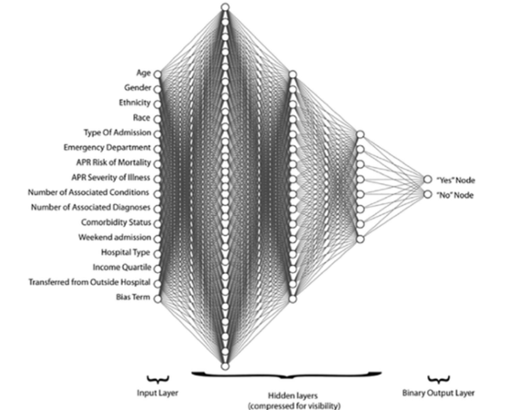
Alongside the artificial neural network in injury prevention, the data set that the ANN uses is generated from an athlete's movements to learn and predict. Technology for "mocap systems" has been used in movie production since the 1980s[iv] but has been adapted to track athletes' biomechanics. By using motion capture technology, doctors and AI can see how an athlete's joints and muscles move to perform movements. For example, if the athlete is performing a jump squat, the motion capture can show the angles at which the joints are moving. This gives insight into which leg the athlete is putting more pressure on that can lead to injury in the future. However, this is not a cheap process to do. Besides needing to pay workers to operate the system and then interpret the results, the setup can cost up to five hundred thousand dollars.[v]
The Process Behind Strategy Optimization
An area that might raise significant controversy is AI optimizing strategy and tactical decision-making. This process seems to be more involved than injury prevention as this is attempting to optimize teams, players, money, and strategy all at once. Because of many factors, the process is split into two sections, backroom decision-making, and on-field decision-making. Backroom decision-making involves scout information, player transfers, and the squad of players available. On-field decision-making involves but is not limited to training, tactics, and team selection.

Each step in tactical decision-making requires its own set of training and validation data and processes to get a complete picture. For example, in the case of tactics/match preparation, deep learning has been applied to model behaviors of players in both basketball and football. Through this, “A simulation is run to see how an AI team would move in certain situations with the AI team created by ‘ghosting’ the characteristics of average and top teams. This helps to identify where teams can make changes to their players’ movements and change events to improve the probability of scoring a basket/goal or reduce the probability of conceding.”[vi] To the right are the results of past ghosting models utilized in basketball.

Using deep learning to have AI simulate matches began research in 2017, a year after Leicester City had won the Premier League. This research is where it becomes worrying for the fairness of sports. Since Leicester won the Premier League in 2016, the technology for optimizing strategy has become much more sophisticated and will only become more accurate. The worry becomes that teams that have much more money to spend willingly will invest more money into AI optimization than a team such as Leicester City would be able to. This issue can also become problematic in American collegiate sports. A primary reason college athletes do not get paid salaries is that recruiting players would become unfair. Better-funded division-one schools can pay athletes high wages. Instead, schools with an abundance of money invest in higher-quality training facilities, locker rooms, coaches, and more. These incentives already push aspiring college athletes to said schools, but what if optimizing strategy becomes the bare minimum needed to attract these athletes. Smaller schools already have issues recruiting top athletes as the advantages of going to a better-funded school are already so great. If these less-funded schools can not provide athletes with this technology to give them faith in being able to compete with these well-known, highly-funded schools, then does this issue become close to one of the reasons schools do not pay college athletes?
The optimizing strategy also uses input from player recruitment of young upcoming players and other players in the sport that can improve a team’s play. This process also utilizes deep learning methods that are used in simulating matches. Looking back at Leicester City, we can again see the issues that can arise from this. Leicester City did not come into the new season after ending the previous season on a losing streak. After being close to relegation, they miraculously saved themselves to stay in the Premier League after a string of impressive wins. After saving themselves from relegation, there still was not much talk about the players themselves, as top coaches did not pay much attention to the bottom of the league table. If AI deep learning was using data from the entire league, Leicester’s best players that led to their championship win could have been discovered by the “Big 6”. Leaving Leicester City unable to match the pay that those top clubs could offer them and may have left them to be again fighting to stay in the league instead of their miraculous championship-winning season.
Do AI strategies have merit?
With the technology for AI to be used in sports being so new, there is the question of how effective it is currently and what the goal is for how effective researchers want it to be. This question relates more to the case of optimizing strategy rather than the case of injury prevention. The benefits of injury prevention are present in the case of lowered rates of concussions in the NFL. Looking particularly at optimizing tactics again and the process of “ghosting” teams, there are critical drawbacks. As of 2017, a vital drawback of the models was that “the model lacked sufficient fidelity to make realistic predictions”. The model could not come to realistic predictions due to the lack of the ability to apply relevant contextual information, current score, and fatigue of players. To prevent this issue, some researchers have attempted to switch this technology from post-game or pre-game use to on-the-field use. Researchers have done this by “analytics courtside for use in in-game decisions by combining data-driven ghosting with a digital sketching interface”.[vii] This combination bypasses problems such as contextual information and score by allowing coaches to use this tool during a game.
This advancement in technology became ready for coaches to try in 2018. Though since then, there has not been much discussion on the technology. We have yet to see coaches readily using it courtside, and there is limited research on new advancements in 2022. In comparison, much more research has been done on injury prevention through AI. The International Conference on Artificial Intelligence in Sports is expected to occur in July 2022. There are already papers selected that discuss new research in injury prevention but none on game optimization or “ghosting”.[viii] This brings the question of how in-depth this technology is still being researched? Is the goal of optimizing through “ghosting” something too far-fetched in 2022 due to the issue of sports being so variable? Do coaches and players believe that their intellect is superior to AI since they understand the human nuances of sports?
AI Effects on Youth Recruitment
One of the most significant ethical issues that need to be addressed is the field of recruitment. Through tracking performance data, teams can predict how a player will interact with the rest of the team once the player is recruited. This issue becomes apparent when this technology becomes widespread at college and youth levels of athletics. Through machine learning, AI can “be applied to discover which other professional players are the scouted player of interest most similar to. These solutions can even project a young player’s future career performance. It can use prediction models from historical data of former rookies and their eventual successes to forecast future performances of current prospects.”[ix]Currently, in 2022, this is not yet the reality, but looking at this ethically, we can begin to see issues of fairness and opportunity. Not all youth players have access to play with sports clubs or expensive private schools where this technology would be available. If a player does not resemble a current player as much, the system may have issues inputting their playstyle into a simulation. Therefore, talented youth players might have more trouble being recruited in the future.
Is it Ethical to use Injury Prevention AI on Youth Athletes?
Furthering the idea of issues surrounding youth players, the area of injury prevention is a concern. As mentioned previously, injury prevention relies on studying an athlete's biomechanics to understand how their movements might lead them to be at high risk for specific injuries. As we have seen from many private companies such as Facebook, companies will gather a user's data and sell it to third-party companies. The selling of private data leads to worries that these new companies creating this technology and selling the service may collect and sell athletes' data to third parties. While this is also a concern for adult athletes, it feels especially concerning for youth athletes who would not understand its implications and how this could be an invasion of their privacy. It is also important to note that as of July 2018, "HIPAA does not cover health or health care data generated by noncovered entities or patient-generated information about health"[x]. It seems that HIPPA does not protect biomechanical data collected for the use of machine learning.
Furthermore, injury prevention does not solely rely on biomechanical movements. Studies have shown that some risk factors for injuries take psychological assessments and stress levels into account. So, psychological data is also at risk of being stored beyond the biomechanical data that can be potentially stored on youth athletes. This causes even more concern regarding privacy since it seems that HIPPA does not protect this data.
Using AI injury prevention on youth athletes in 2022 is not an area of concern for the general public. There have been studies done using AI on youth athletes since 2018 through the work of gathering data on soccer players (aged 18-13). From a study in 2004, it was found that the average injury rate per player per season is 0.40 and the time spent recovering from said injuries accounted for 6% of a youth player's development time.[xi] With the common occurrence of injuries in youth programs that take away from their development time, introducing technology that can help prevent this seems ethical. It can be ethical as long as their data is used for the sole purpose of helping prevent injuries and their development as players. Since, in 2022 in America, it seems that their data is not protected, it becomes worrisome that their data can be used in unethical ways. Though if new regulations were made to protect youth athletes from having their data exploited, this could be an ethical solution to a common problem in youth athletics.
Brief Future Outlook
Looking at all aspects of AI in sports, I believe there is a place for AI technology. Besides the inevitable in areas such as bookmaking and the fantasy sports realm, I think that injury prevention and player development will play a massive role in the advancements of all sports. As someone who has struggled with injuries from a young age because of athletics, I believe that if I had access to this technology, I would have struggled with fewer injuries. I learned later in life that I would favor one leg over the other, which led to me having tendonitis in one knee. However, if I had access to these new AI advancements, this problem could have been identified at the start, and I could have avoided the years of pain I have dealt with in one knee.
That benefit of injury prevention is without even mentioning what it has done in professional sports. Through this use of AI, the NFL has reduced the occurrence of concussions in their sport by 38%, that alone should warrant the use of AI throughout more sports to prevent injuries. Sports are a beloved part of human culture, and to keep seeing world-class players be involved for as long as they can, everything that can protect their health should be done. Regarding optimizing strategy, the problems associated should fix themselves over time. Optimizing strategy through deep learning is still new, meaning that the strategies it computes are not perfect, and the technology to do so is still expensive. This means that in 2022 only the teams/clubs/colleges that can afford this are still not relying on this information. By the time it begins to be perfected, the cost of using this will most likely decrease, allowing access to teams with less funding. I do not believe this will ruin the game but will increase the skill level of players and coaches. It will force players and coaches to be more adaptive as the two AI-optimizing strategies compete against each other. AI deep learning can potentially bring athletes and sport strategy that we have yet to see. If the technology continues to be researched, it can begin an exciting new area for coaches, athletes, and spectators alike.
Endnotes
[i]. Li, Bin, and Xinyang Xu. 2021. “Application of Artificial Intelligence in Basketball Sport”. Journal of Education, Health and Sport 11 (7):54-67. https://doi.org/10.12775/JEHS.2021.11.07.005.
[ii]. Claudino, Joao. 2019. “Current Approaches to the Use of Artificial Intelligence for Injury Risk Assessment and Performance Prediction in Team Sports: a Systematic Review.” SpringerLink. https://link.springer.com/article/10.1186/s40798-019-0202-3
[iii]. “Using Artificial Intelligence to Advance Player Health and Safety.” 2019. NFL.com. https://www.nfl.com/playerhealthandsafety/equipment-and-innovation/aws-partnership/using-artificial-intelligence-to-advance-player-health-and-safety.
[iv]. “100 years of motion-capture technology.” 2018. Engadget. https://www.engadget.com/2018-05-25-motion-capture-history-video-vicon-siren.html.
[v]. “The complete guide to professional motion capture.” n.d. Rokoko. Accessed April 16, 2022. https://www.rokoko.com/insights/the-complete-guide-to-professional-motion-capture.
[vi]. Beal, Ryan. 2019. “Artificial Intelligence for Team Sports: a survey.” Cambridge Core. https://www.cambridge.org/core/journals/knowledge-engineering-review/article/artificial-intelligence-for-team-sports-a-survey/2E0E32861D031C022603F670B23B55B3.
[vii]. 2018. Bhostgusters: Realtime Interactive Play Sketching with Synthesized NBA Defenses. https://sportin-tech.com/wp-content/uploads/2020/05/2018_Seidl_MITSSAC_BhostgustersRealtimeInteractivePlaySketchingwithsynthesizedNBADefenses.pdf.
[viii]. “International Conference on Artificial Intelligence in Sports ICAIS in July 2022 in Paris.” n.d. World Academy of Science, Engineering and Technology. Accessed April 18, 2022. https://waset.org/artificial-intelligence-in-sports-conference-in-july-2022-in-paris.
[ix]. Martinez, Guillermo. 2021. “Artificial Intelligence (AI) in Sports.” Sport Performance Analysis. https://www.sportperformanceanalysis.com/article/artificial-intelligence-ai-in-sports.
[x]. Cohen, Glenn, and Michelle M. Mello. 2018. “HIPAA and Protecting Health Information in the 21st Century.” JAMA Network. https://jamanetwork.com/journals/jama/fullarticle/2682916.
[xi]. Price, RJ. 2004. “The Football Association medical research programme: an audit of injuries in academy youth football.” BMJ Journals. https://bjsm.bmj.com/content/38/4/466.abstract.